Introduction
In today’s world, sustainability and corporate social responsibility are more important than ever. Companies and investors are increasingly focused on environmental, social, and governance (ESG) practices to ensure a sustainable future.
The GRESB (Global Real Estate Sustainability Benchmark) plays a crucial role in this scenario, providing detailed assessments of the ESG performance of companies and real estate and infrastructure assets.
Why is GRESB important?
The goal of GRESB assessments is to capture the most relevant ESG data related to the sustainability performance of companies and assets.
Investors use this data to assess organizational exposure to various risks and identify new investment opportunities in well-performing companies.
Alignment with ESG Frameworks
To ensure that its assessments remain relevant and effective, GRESB relies on independent standards that are reviewed annually by the GRESB Foundation. Part of this process involves reviewing and mapping other important frameworks and standards to understand where and how GRESB standards can align.
Key Alignment Frameworks
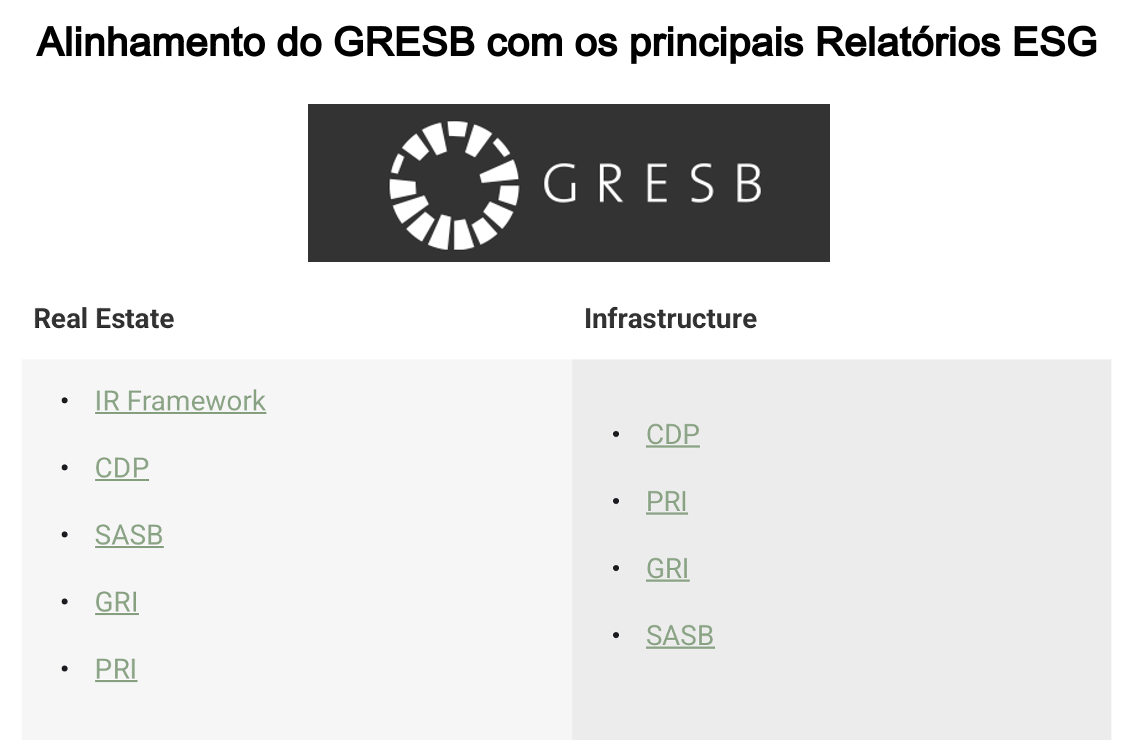
GRESB maps relevant indicators from external frameworks, such as CDP, SASB, GRI, and PRI, to its own standards.
This helps to analyze the level of alignment between GRESB indicators and those of other frameworks, reducing the reporting burden for companies.
Here are some of the main frameworks:
- CDP (Carbon Disclosure Project) : Focused on disclosing data related to climate change, the CDP helps companies measure and manage their environmental impacts, especially in terms of carbon emissions. GRESB aligns with the CDP in areas such as risks and opportunities, business strategy, targets and performance, emissions methodology, and verification.
- SASB (Sustainability Accounting Standards Board) : Provides specific standards for different sectors, helping companies report relevant financial information related to sustainability. GRESB has a high rate of alignment with SASB indicators, especially in the objectives and scope of indicators for the real estate sector.
- GRI (Global Reporting Initiative) : One of the most widely used frameworks, the GRI provides guidelines for preparing sustainability reports that cover a wide range of ESG issues. GRESB aligns with GRI environmental standards, especially in indicators related to environmental performance.
- PRI (Principles for Responsible Investment) : A set of UN-backed principles that help investors incorporate ESG issues into their investment and ownership decisions. GRESB aligns with the PRI on topics such as policy, construction and development, reporting disclosure, and third-party monitoring.
Benefits of Alignment
Although the frameworks were created for different purposes, understanding the degree of alignment between them is useful when considering potential changes and how to reduce the overall reporting burden.
A high degree of alignment does not necessarily reflect the value of a specific framework, but rather the efficiency and consistency in the collection and analysis of ESG data.
Benefits of GRESB for Companies in Brazil
For companies operating in Brazil, adopting GRESB can bring several significant benefits:
- Access to Investment : GRESB is widely recognized by institutional and financial investors. Companies that utilize GRESB can attract more investment because they demonstrate a clear commitment to robust ESG practices.
- Improved Reputation : Adopting sustainable practices and transparency in ESG reporting can significantly improve a company’s reputation. This is particularly important in Brazil, where awareness of environmental and social issues is growing.
- Comparison with Competitors : GRESB allows companies to compare their ESG performance with that of their peers, both locally and internationally. This can help identify areas for improvement and adopt industry best practices.
- Risk Reduction : The GRESB assessment helps companies identify and mitigate environmental, social, and governance risks. This is crucial for ensuring long-term sustainability and avoiding regulatory and reputational problems.
- Operational Efficiency : Implementing ESG practices can lead to greater operational efficiency, such as reduced energy and waste costs. This not only benefits the environment but can also result in significant financial savings.
Conclusion
GRESB continues to evolve and adapt to market needs, ensuring that its assessments remain a valuable tool for investors and companies committed to sustainability.
By aligning with leading ESG reporting frameworks, GRESB facilitates a more efficient and effective reporting process, promoting sustainability practices across the real estate and infrastructure sectors.
For companies in Brazil, adopting GRESB can be a strategic step to improve their ESG performance, attract investment, and ensure a sustainable future.
Contact for Alignment and Strategy Review
To ensure your company is fully aligned with GRESB criteria and to create an easy-to-follow strategy to achieve GRESB objectives, contact Sustain Quality .
Our team of experts is ready to help your organization navigate the GRESB assessment process, offering a detailed alignment review and developing a customized strategy to meet your specific needs.
Contact us today and take the first step towards improving your ESG performance and ensuring a sustainable future for your company.