Client Name: 346 Clapham Road
Type of Project: Whole Life Cycle Assessment
Location: 346 Clapham Road, London SW9 9AP
Scope of Whole Life Cycle Assessment
Sustain Quality Ltd were commissioned by Ream Projects to undertake a Whole Lifecycle Carbon Assessment for the proposed development at 346 Clapham Road, London SW9 9AP. The aim was to compare the carbon emissions (CO2-equivalent) between the proposed development and the existing building, including embodied and operational carbon. Reasonable improvements were incorporated.
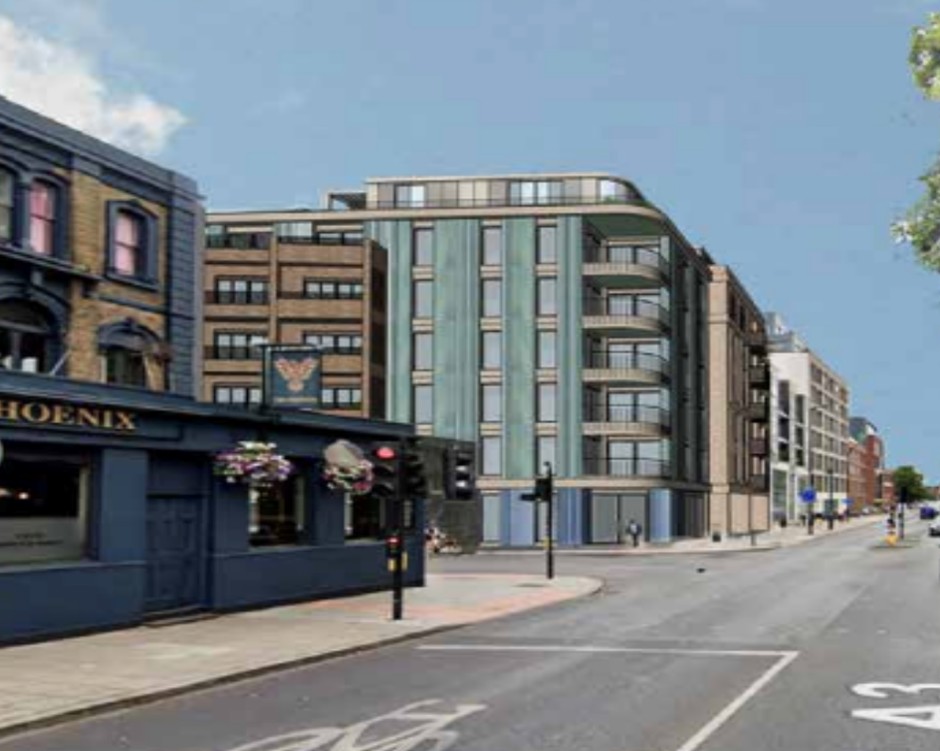
The proposed development involves demolishing a 4-storey office building and replacement with a mixed-use redevelopment featuring 3 office units on the ground and lower ground floors and 30 residential units on the upper six floors. The office spaces are designed for small to medium businesses, with cycle and bin storage at the lower ground level and access to a courtyard. Residential units include private and communal amenity spaces, with dedicated cycle and bin storage on the ground floor, all accessed via a single stair and lift core.
Tools for Task Implementation
The BRE-certified Integrated Environmental Solutions Virtual Environment (IES-VE) software was used for modelling the existing and proposed buildings’ material quantities and dynamic energy simulation, providing operational energy figures.
For the Whole Life Cycle Carbon Assessment, the One Click LCA tool was utilised, which is BRE certified, follows EN 15978, and is IMPACT compliant.
The RICS professional statement (PS) and the Greater London Authority’s Whole Life-Cycle Carbon Assessments Guidance (March 2022) for undertaking detailed carbon assessments were followed. The RICS Whole Life Carbon Assessment for the built environment (1st Edition, 2017) follows the European standard EN 15978.
Challenges for Task Implementation
It is challenging to make any direct comparisons between the existing and proposed buildings, due to the differences in mass and intended usage.
Solutions
A comparison of the resulting whole life carbon per square metre of gross internal floor area was done.
Results
The carbon embodied in the product and construction stages of the proposed development are significantly increased.
However, this is offset by the lower operational energy use per square metre.
A comprehensive strategy has been developed to combine the demolition of the existing property with the construction of the proposed new dwelling.
Key commitments and design strategies have been defined to maximise opportunities for disassembly, adaptability, material reuse on-site and/or recycling, supporting a circular economy, emphasising reduced resource use, minimised waste and effective waste management.
Benefits of Whole Life Cycle Assessment in Redevelopments
Whole Life Cycle Assessments assist in performing a comparison of the environmental impacts of renovating existing structures against demolishing and building anew. It helps to evaluate potential sites for redevelopment with the lowest environmental impact. An analysis of design alternatives for redevelopment identifies options with the lowest environmental impact. The building’s environmental hotspots are identified so they can be prioritised for upgrades and replacements. It also evaluates the lifetime impact of materials promoting circular economy practices by prioritising reuse where feasible.
Location
346 Clapham Road, London